
VoIP is not an emerging technology anymore. It is here and advancing at a significantly rapid pace.
If we talk about the early days of VoIP, the early adopters used to face issues like the compatibility, flexibility and affordability of the technology. However, as the technology grew and became a widely used communication tool for both businesses and household consumers, its users’ started focusing on security concerns.
But before we move on to VoIP security, let’s take a quick look at what VoIP is and how it works.
What Does VoIP Stand for?
Short for Voice over Internet Protocol, VoIP communication is conducted on IP networks. Yes, the same network on which you use the Internet. And because of the IP network, users get to reduce their calling expenses by a huge percentage.
How Does VoIP Work?
Since the VoIP communication uses IP network, the data or communication is transmitted in the form of packets. Secondly, just like we need an ISP to connect to the Internet, we need to subscribe to a VoIP service to use VoIP network in our home or offices.
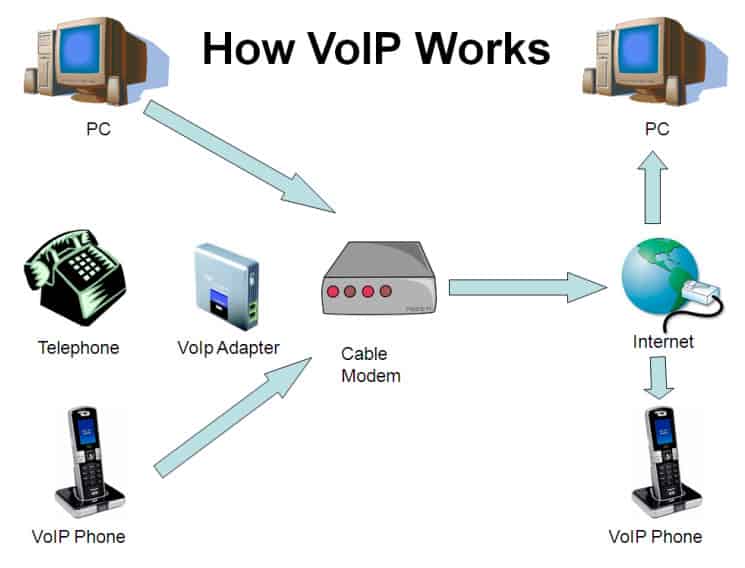
Usually VoIP calls require either softphone (VoIP software) or VoIP enabled IP phones. However, traditional telephones can also be used for VoIP call by using analog telephone adapters.
Most Common Security Threats VoIP Users Encounter
VoIP can be a secure communication means as long as it is conducted through a robust private network; for instance, an internal business telephone network. However, as soon as you move VoIP to the public Internet, your network is exposed to all kinds of security threats creeping around on the Internet.
What kinds of threats? Let’s take a look at them:

Image Courtesy of: Securityintelligence.com
Service Theft
You may have heard of cyber-attacks where hackers steal users’ private information – better known as identity theft. However, in VoIP, the attacker can even steal the service itself. By hacking the service, the attacker can get access to the VoIP credentials, i.e., SIP (Session Initial Protocol).
Vishing
Voice phishing is also known as vishing. Service theft, among many other tactics, can also lead to Vishing attacks where the attacker spam the victims with fake calls and lure them into revealing sensitive personal information such as social security number, credit card number or even social ids.
Eavesdropping
Don’t compare VoIP eavesdropping with the traditional eavesdropping where someone secretly listens to your private communication. When it comes to Voice over Internet Protocol eavesdropping, the attacker can get your phone numbers, ids and passwords. Moreover, the attacker can take over all your controls on call billings, plans and even voicemails.
Malware
When VoIP communication is conducted through softphones, rather than physical phones, your communication is exposed to security threats like malware and viruses. Malware attacks can further expose you to other attacks like denial of service attack, phishing, identity theft, etc.
DoS
DoS stands for Denial of Service attack. As the name suggests, when someone carries out a DoS attack, the victim is denied of the services that are targeted. For instance, in VoIP DoS attacks, the hacker targets a service or a network with a flood of SIP messages. As a result, users get to experience degraded service which results in call drops and call halts, to name a few.
Man-in-the-Middle
Man-in-the-middle is an online attack which is also common in VoIP communication. The attacker gains access to the communication by interrupting the SIP messaging.
Call Tempering
As the name suggests, the attack is carried out to temper with the victim’s call. The attacker can degrade the quality of the call by withholding data packets or sending noise packets.
How to Protect Your VoIP Traffic
Luckily, there are a number of ways you can protect your VoIP traffic or network and keep hackers at bay.
- You may start with using strong passwords.
- Secondly, you can encrypt the media packets through robust protocols like SRTP.
- You may also use a VPN to encrypt the entire communication. A VPN (Virtual Private Network) can offer you solid encryption making not just the packets but also the device fully encrypted.
- Install firewalls or antimalware applications to keep your device protected against malware attacks. You may also use advance intrusion detection and prevention system (IDS/IPS) for ultimate security.
- Always keep your operating system up-to-date with the latest security patches. By using latest security updates, you get to prevent any security exploitation that is usually done through vulnerabilities found in older versions.
- You should also keep an eye on any sort of abnormal behavior on the network and report it to the service provider.
How PureVPN Helps With VoIP Calling
PureVPN is the ultimate cyber security tool you can avail to make your VoIP fully protected. How?
Encryption
PureVPN uses 256bit AES military-grade encryption that offers protection from all kinds of threats. When you connect to PureVPN and start VoIP, you can carry out your communication in a protected environment. PureVPN offers multiprotocol functionality giving you easy access to a range of protocols such as OpenVPN, IKEv2, PPTP, etc.
IDS/IPS
One of the best features that make PureVPN the ultimate security tool is IDS/IPS (Intrusion Detection System and Intrusion Prevention System). The feature comes with advanced protection keeping your VoIP network and calls safe from intruders.
Access Geo-Restricted VoIP Applications
There are certain regions where some VoIP applications are not allowed. Though the reasons could be any, but the non-availability of the application puts many users at discomfort. For instance, many users can’t make affordable calls that some VoIP applications offer. A VPN allows you to circumvent the restriction and enjoy VoIP on any application they want.
Large VPN Servers Pool
PureVPN has 740+ servers in several countries across the globe. This gives users a great advantage to make high quality calls that are not plagued with disconnects, low-voice quality, etc.
Conclusion
VoIP may probably be the most affordable communication means of the 21st century. However, like many other applications or devices connected to the Internet, VoIP is also vulnerable to online threats. Therefore, it is best to take the necessary measures to protect your VoIP communication and keep your private information from getting into the wrong hands.

PureVPN

June 20, 2023

3 years ago


